One of the first things people realize when they become interested in technology is that IT is much bigger than they expected.
At first, it may seem simple. You hear about programming, maybe cybersecurity, maybe AI, and it sounds like the tech world is made of a few obvious paths. But the moment you look a little closer, everything starts to feel wider, more complex, and honestly a bit overwhelming.
That is usually when the question shows up: what can I actually do in IT?
And that is a very important question, because a lot of beginners are not confused because they lack ability. They are confused because the field is broad, and nobody really explains it in a simple way at the beginning.
Many people assume IT is basically coding. If they do not want to become programmers, they start wondering whether there is still a place for them in tech. The answer is yes – absolutely.
Programming is one path, but it is not the whole field. IT includes many different areas, and some of them are much more practical, people-focused, operational, or systems-based than most beginners realize.
That is actually good news.
It means technology is not reserved for one type of person. It means there are different ways to enter, different ways to learn, and different strengths that can matter.
IT is not one job
When people say “I want to work in IT,” they are often talking about a field that includes many different kinds of work under the same umbrella.
IT is the space that helps technology function inside real life. It includes the computers people use, the systems companies rely on, the networks that connect everything, the accounts and permissions behind daily operations, the security that protects information, the cloud services that support modern business, the data that organizations depend on, and the technical environments working quietly in the background.
That is why the field feels so broad.
Two people can both work in IT and have completely different daily routines. One may spend the day helping users solve access problems. Another may be configuring systems. Someone else may be focused on cloud environments, security monitoring, databases, or infrastructure. They are all in tech, but not doing the same kind of work.
For beginners, understanding that changes everything. It takes IT out of the “all or nothing” category and turns it into something much more understandable.
Why this matters for beginners
At the beginning, you do not need to choose your entire future. But it helps a lot to know what the main paths are.
Without that visibility, many people study in a very scattered way. They watch random videos, hear trendy terms, try to follow advice made for people at a completely different level, and end up feeling like they are behind before they have even started properly.
Knowing the main areas of IT gives you something simpler: direction.
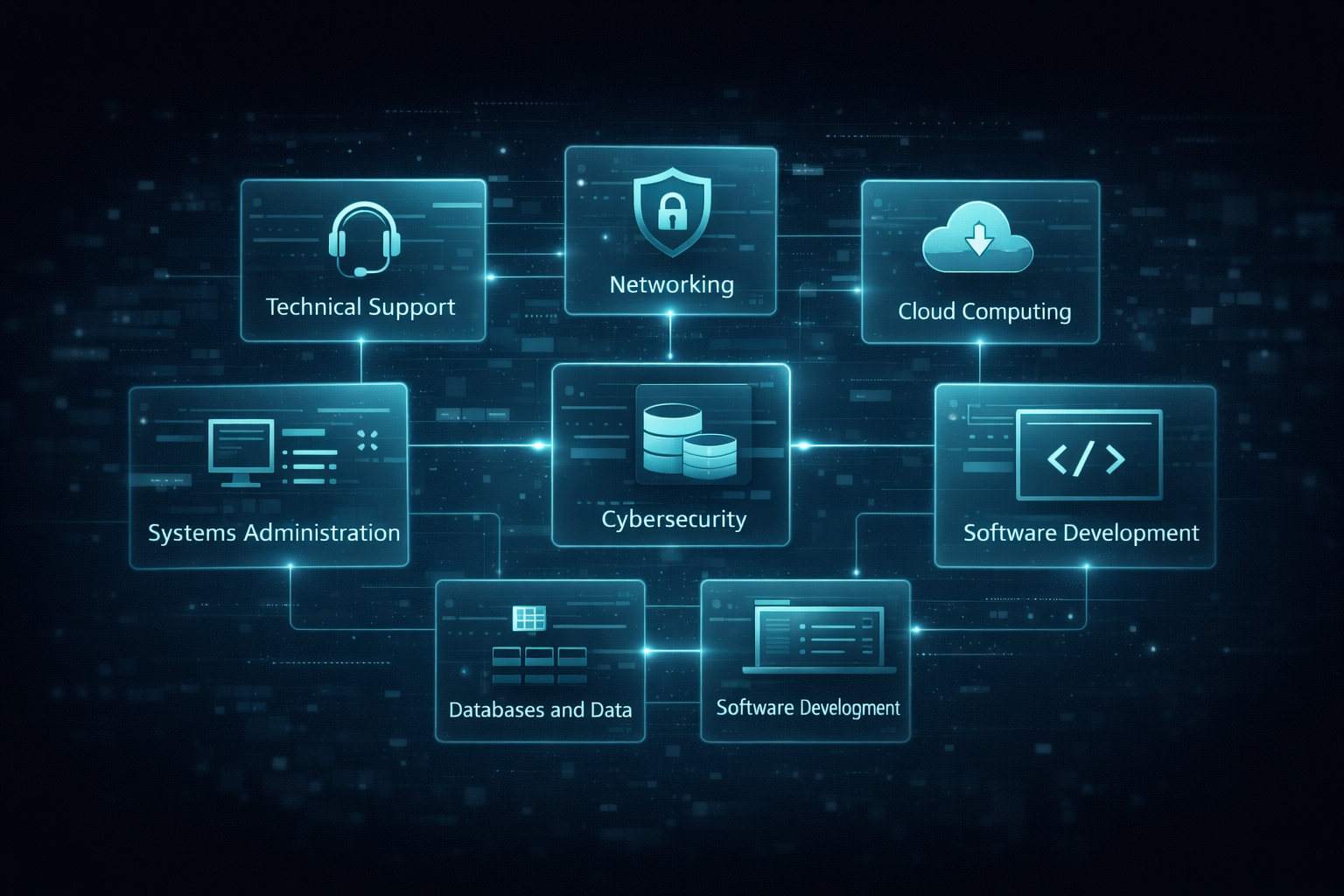
It helps you understand where different interests can lead. It helps you notice that support is different from networking, that cybersecurity is different from systems administration, that cloud is different from software development, and that none of these paths needs to be mastered all at once.
You are not supposed to know everything on day one. You are supposed to begin.
Where many people begin: support
For a lot of beginners, one of the most realistic entry points into IT is support.
This is the area where people help users solve everyday technical problems inside a company or organization. It can involve login issues, password resets, software access, email problems, printer problems, device setup, and general troubleshooting. In other words, it is the kind of work that puts you face to face with how technology behaves in the real world.
Some people underestimate support because it sounds too basic. But in reality, it can be one of the most useful starting points in tech.
Support teaches you how to think through problems, how to communicate clearly, how to stay calm when something is not working, and how systems affect real users. It also gives you exposure to many practical situations that build confidence faster than theory alone.
For someone who wants a strong starting point, it is often one of the best places to begin.
Networking, systems, and the structure behind everything
As people go deeper into IT, they often start becoming curious about how everything connects.
That is where networking begins to matter. It is the area that helps explain how devices communicate, how internet connections behave, how internal systems stay linked, and why so many technical problems are connected to connectivity in one way or another. Even basic networking knowledge already helps a beginner understand technology more clearly.
Then there is systems administration, which is more focused on keeping environments organized, functional, and stable. This can involve user accounts, permissions, installations, updates, internal settings, monitoring, and sometimes servers. It is less about flashy technology and more about making sure the environment keeps working the way it should.
These areas often appeal to people who like structure, logic, and understanding what keeps an organization running behind the scenes.
Security attracts attention — but fundamentals still come first
Cybersecurity is one of the areas that gets the most attention from beginners, and that is easy to understand. Security sounds important, modern, and high value – because it is.
It focuses on protecting systems, accounts, networks, and information. It deals with risk, access, safe practices, monitoring, vulnerabilities, and digital protection in general.
But there is something important that beginners need to hear clearly: cybersecurity usually makes much more sense when the fundamentals are already in place.
A person does not need to start directly in security to move toward it. In fact, many people build their path into security through support, networking, systems, or general IT knowledge first. That foundation matters because it is hard to protect what you do not yet understand.
So yes, cybersecurity is a real and valuable direction. But like many things in tech, it becomes clearer when the basics are strong.
Cloud, data, and development are also part of the picture
Modern IT also includes cloud computing, which has become one of the most important parts of how companies operate today. Many services, systems, and environments no longer depend only on local machines or physical offices. They live in cloud platforms, remote infrastructure, and online environments that can scale much more easily.
Then there is the world of data and databases, where the focus is on storing, organizing, accessing, and managing information. For people who like logic, structure, and working with information in a more organized way, this can become a very interesting direction.
And of course, there is software development – the area many people hear about first. This is where websites, applications, automations, systems, and digital products are created through code.
It is an important area, but it is still only one area.
That point matters because many beginners think tech begins and ends with programming. If they are not drawn to coding, they assume they do not belong in IT. That is simply not true. There are many ways to build a future in technology, and not all of them require the same kind of work.
So what is the best area for a beginner?
There is no universal answer, because people are different.
Some people enjoy solving practical user problems. Some are curious about networks. Some like structure and systems. Some are interested in protection and security. Some love the idea of building software. Some prefer the operational side of technology that keeps everything stable in the background.
What matters at the beginning is not choosing the perfect path immediately.
What matters is building enough understanding to move forward with clarity instead of confusion.
For many beginners, the best starting point is not a highly specialized area at all. It is the combination of computer basics, digital confidence, basic troubleshooting, and a simple understanding of what the main areas in IT actually are. From there, it becomes much easier to explore one direction at a time.
Final thoughts
The biggest mistake many beginners make is thinking they need to figure out everything before they begin.
They do not.
IT is a broad field, and that can feel intimidating at first. But it can also be encouraging. It means there is more than one path in. More than one way to learn. More than one kind of skill that matters.
Some people start with support and later move into systems. Some begin with curiosity about networking and end up in cloud. Some build a strong foundation and later move toward cybersecurity. Some discover that development is the right fit. Others find their place in infrastructure, operations, or data.
The important thing is not knowing the entire map on the first day.
The important thing is realizing that there is a place to start.
And once you understand that, IT stops feeling like a giant wall and starts feeling like a field you can actually enter – one step at a time.