We use computers every day, but most people never really stop to think about what a computer actually is.
It is just there – on the desk, in your hand, in the supermarket, at the bank, inside the systems you use at work, and behind a huge part of modern life. But if you want to understand technology better, one of the best things you can do is start with the most basic question of all: what exactly is a computer?
That is where a lot of people get stuck. They want to learn about tech, AI, cybersecurity, programming, or IT support, but skip the foundation. The problem is simple: when the basics are weak, everything else feels harder than it needs to.
Learning technology is a lot like learning to drive. You do not begin by racing down the highway. First, you learn what each part does, how the machine works, and how to control it. Technology works the same way. Before going deeper, it helps to understand the machine in front of you.
So, what is a computer?
The word computer comes from the idea of computing, which means calculating, counting, or evaluating. In the simplest sense, a computer is a machine designed to process information and carry out instructions.
That may sound technical, but the idea is actually very straightforward. A computer takes input, processes it, and produces output. You click, type, save, open, search, print, watch, edit – and the computer handles those instructions almost instantly.
At its heart, that is what it does: it helps humans perform tasks faster, more accurately, and with less effort.
A quick look at how we got here
Computers did not suddenly appear as sleek laptops and smartphones. The history goes much further back.
Long before modern machines existed, people were already creating ways to count and organize information. One of the earliest examples is the abacus, which is often considered one of the first tools used for calculation. Over time, as writing, paper, numbering systems, and mechanical inventions developed, human beings kept finding better ways to store and process information.
Then, in the 19th century, Charles Babbage designed mechanical calculating machines that would later inspire the development of modern computing. From there, things accelerated.
The evolution of computers is usually divided into generations:
- First generation: vacuum tubes, massive machines, mostly used for military and scientific work
- Second generation: the beginning of commercial computing
- Third generation: transistors made computers smaller and faster
- Fourth generation: chips improved reliability and reduced cost
- Fifth generation: processors helped bring computing into everyday life
What was once giant, expensive, and limited to specialists gradually became personal, accessible, and part of daily life.
Hardware vs. software
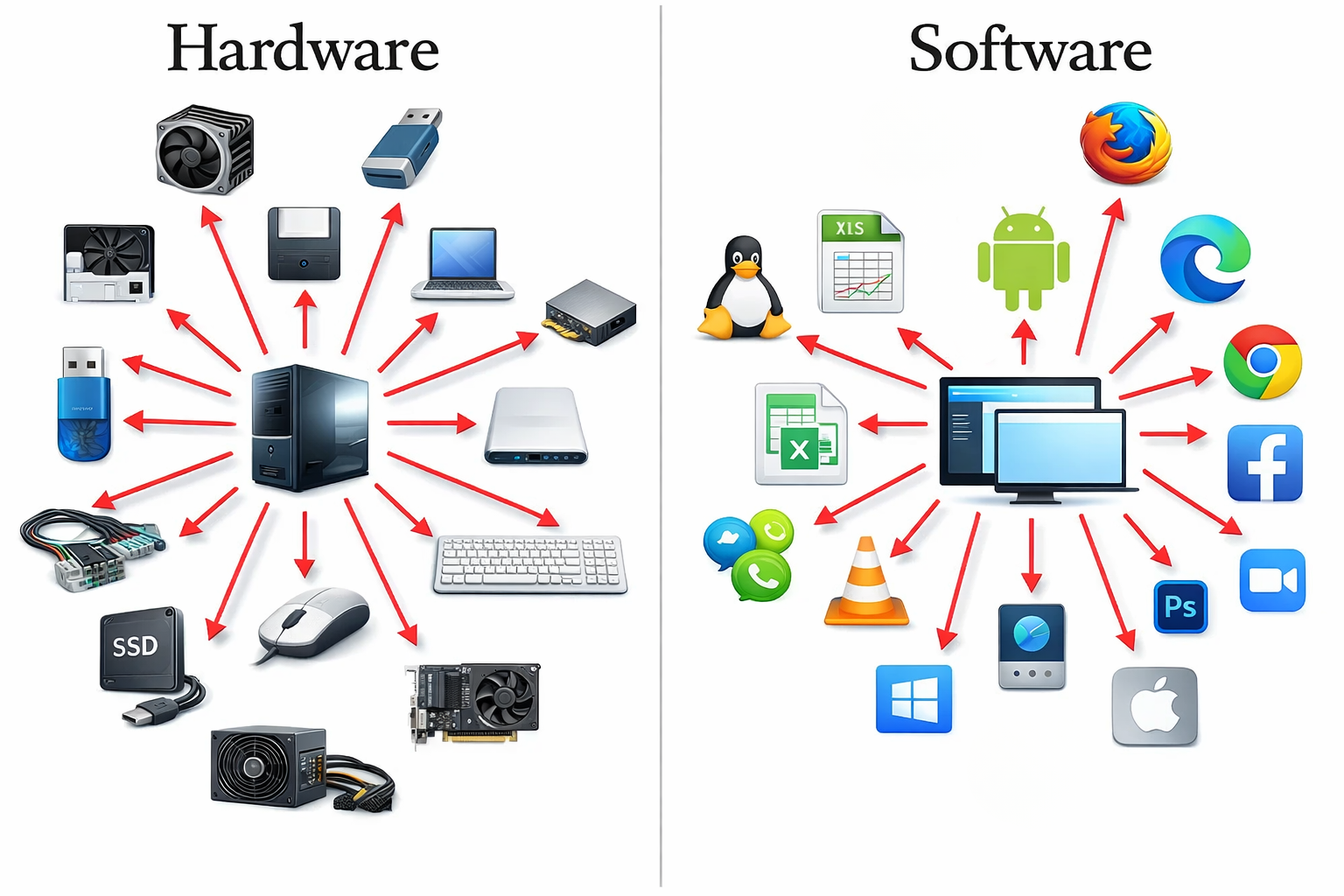
If you remember only one thing from this post, let it be this: every computer depends on two essential parts – hardware and software.
Hardware is the physical side of the computer. It is everything you can actually touch: the keyboard, the monitor, the mouse, the motherboard, the processor, the storage drive, and the rest of the machine.
Software is everything that tells the hardware what to do. Your operating system, browser, apps, text editor, video player, and games are all software. You cannot hold software in your hand, but without it, the hardware would not know what to do.
A funny way to remember the difference is this:
- If you can kick it, it is hardware
- If you can only yell at it, it is software
Not very scientific, maybe – but very memorable.
And honestly, it works. When the keyboard stops responding, you are dealing with something physical. When the app freezes for no reason and tests your patience, that is software. Different problems, different causes, same frustration.
Why this distinction matters
At first, hardware and software may seem like simple definitions, but understanding the difference makes technology much easier to follow.
When something goes wrong with a computer, one of the first questions is whether the problem is physical or digital. Is it the machine itself, or is it the program running on it? That basic distinction is the beginning of troubleshooting, and it is also one of the first steps toward feeling more confident around technology.
This is why the basics matter more than people think. They are not boring details. They are the foundation.
Computing is much bigger than the screen in front of you
When people hear the word computer, they often imagine a desktop or a laptop. But computing is everywhere.
It is in hospitals, schools, banks, supermarkets, airports, offices, traffic systems, farms, and homes. It is in self-checkout machines, digital payments, online classes, automatic doors, medical records, and navigation systems. In many cases, we do not even notice it. It becomes invisible because it is already built into everyday life.
And that is exactly why learning the basics of computing matters so much. You are not learning about some distant subject that only matters to people in tech. You are learning about something that already shapes the world around you.
Final thought
A computer is not just a machine on a desk. It is a system that combines physical components and digital instructions to process information and help us do things more efficiently.
Once you understand that, technology starts to feel less intimidating.
You do not need to be a genius to begin. You just need to start with the right foundation.
Next in the series: Inside the machine – the main parts of a computer, explained simply.